EN

How baler twine is specified, how PP compares with sisal, which grade suits your baler and bale type — and what to check before placing a container order.
1. What is baler twine?
Baler twine — also called baling twine or press twine — is the cord that binds straw, hay or silage into a bale inside a baler. It has to survive a demanding job: feed smoothly through the machine's twine channels and knotter at speed, take a knot that holds under sustained load, and then hold the bale's shape for months outdoors in sun, rain and fermentation heat.
Today the material is overwhelmingly polypropylene (PP), extruded into flat tapes, fibrillated (split into fiber bundles), twisted and UV-stabilized. Sisal — a natural fiber — survives in niche markets but has been largely displaced. The twine is supplied on spools, typically 5–10 kg, designed to be pulled from the centre so the spool stays put on the baler's twine box.
It matters commercially because it's a repeat-purchase consumable: a farm or contractor that switches to your twine reorders every season. That's what makes the category attractive to distributors and farm-supply chains — and why twine quality failures (breakage at the knot, tangles, UV degradation) destroy accounts faster than price wins them.
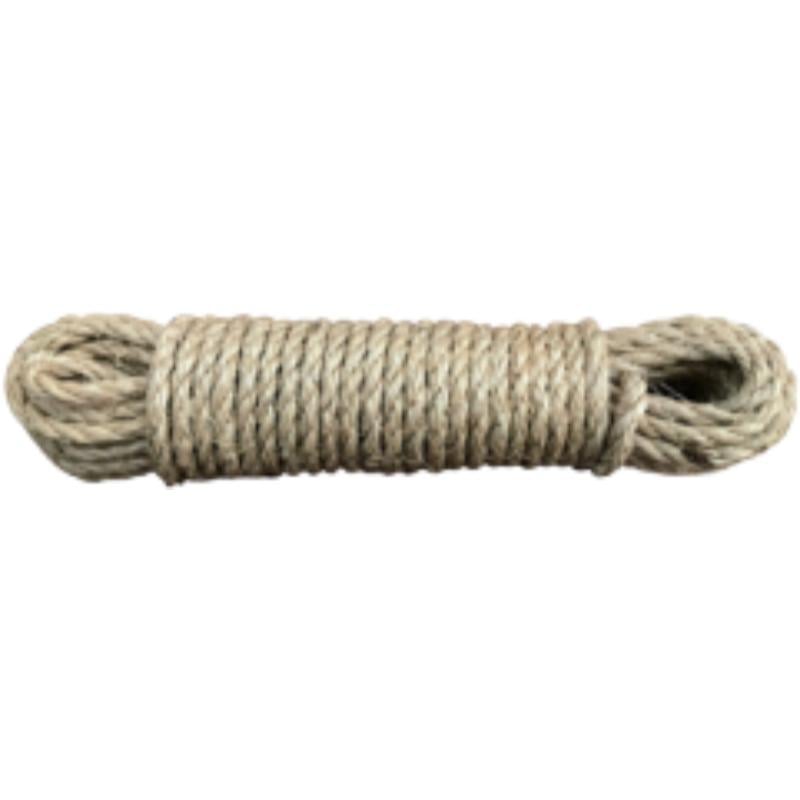
2. PP vs sisal twine
| Property | PP baler twine | Sisal baler twine |
|---|---|---|
| Tensile strength | Higher at equal linear density; grades up to ~520 kgf | Lower; typically suited to high-pressure square bales |
| Knot security | Knots hold firmly; knot strength ~60–75% of tensile | Good knot hold, but fiber degrades when wet |
| Weather / UV | UV-stabilized PP; rot-resistant; multi-season outdoor storage | Biodegrades outdoors; limited outdoor life |
| Moisture | Unaffected by wet silage bales | Absorbs moisture; loses strength in humid storage |
| Consistency | Machine-made, uniform linear density — predictable knotter feeding | Natural fiber; batch-to-batch variation |
| Cost per bale | Lower on strength-per-dollar; lighter coils | Higher where available; regional supply only |
Verdict for modern operations: PP wins on strength, consistency and outdoor durability. Sisal retains a following among organic and traditional operations that value biodegradability — but for commercial hay and silage, PP is the global default. (Our PP vs sisal comparison breaks this down further.)
3. Reading the specs: m/kg, tensile & knot strength
Linear density (m/kg) — the master spec
Baler twine strength is not quoted in millimetres — it's quoted as metres per kilogram. The relationship is inverse and absolute: fewer metres per kilo = thicker yarn = stronger twine. A 1,000 m/kg twine is a fine cord for round balers; a 110 m/kg twine is a heavy cable for large square balers. Getting this number wrong for your baler causes either breakage (too thin) or knotter jams and waste (too thick).
Tensile strength (kgf)
The load at which the twine breaks. Published grades span 40–520 kgf depending on linear density and manufacturer. Tensile strength matters less than it looks, though — because the knot, not the straight section, is the weak point.
Knot strength (kgf) — the number that actually fails
The load the twine holds after the baler's knotter ties it. Industry experience puts knot strength at roughly 60–75% of tensile. When a bale "bursts" in storage, the cause is almost always a knot that slipped — so when comparing suppliers, compare knot strength, not headline tensile. Reputable catalogs publish both figures; if a supplier quotes only one, ask for the other.
UV stabilization and fibrillation
Ask for the UV stabilizer content and the fibrillation method. Good mechanical fibrillation produces the fiber bundles that give PP twine its strength and knot-holding grip; under-fibrillated twine untwists in the knotter. UV stabilization determines whether coils survive a season of outdoor storage — look for a stated outdoor life of at least 12 months.
4. Spec grades by bale type
The table consolidates typical published grades from major agricultural twine manufacturers. Use it to sanity-check any quote against industry norms.
| Application | Linear density (typical) | Tensile strength (typical) | Knot strength (typical) |
|---|---|---|---|
| Round balers (high m/kg twine, up to ~20 wraps) | 580–1,000 m/kg | 40–75 kgf | 22–38 kgf |
| Round balers (heavier grade / net-replacement twine) | ~750 m/kg | ~69 kgf | ~38 kgf |
| Small square bales | 280–410 m/kg | 100–145 kgf | — |
| Large square bales (standard density) | 110–150 m/kg | 310–380 kgf | 210–260 kgf |
| High-density large square bales | 85–105 m/kg | 400–520 kgf | 275–350 kgf |
| High-pressure small bales (sisal) | ~200 m/kg | — | — |
Source: published product specifications from established agricultural twine manufacturers (European and Chinese catalogs, 2024–2026). Ranges reflect common commercial grades; exact values vary by manufacturer.
5. Matching twine to your baler & knotter
Three machine-side factors decide the correct twine:
- Baler type: round balers need fine, high m/kg twine (they wrap many times — up to ~20 cords per bale); large square balers need 4–6 heavy cords; small square balers use 2 cords of medium twine.
- Knotter type: Deering and Claas-style knotters dominate. Each has a window of twine thickness it ties reliably — too thick and the knotter jams or makes a loose knot; too thin and the knot slips. The baler manual's twine spec is the authoritative answer.
- Twine channels: count them. The machine's channel count and bale size determine how many cords run per bale, which drives your twine consumption math (below).
Practical tip: when trialing a new twine, run it alongside your current brand on the same field. Knot failure rate after two weeks of storage — not first-day performance — is the verdict.
6. Hay vs silage: what changes
Hay is dry and light: standard grades work, and the risk is twine stretching or loosening over a long storage period. Silage is wet, heavy and fermenting — bales can exceed 700 kg, and fermentation generates heat. Silage demands a heavier grade (lower m/kg, higher knot strength) and rot-resistant PP, because natural fibers degrade in contact with moist forage. Under-specified twine on silage bales fails at the knot during handling, typically at the least convenient moment.
7. Estimating consumption
A rough consumption model for planning orders:
- Round bales (4×4 ft, ~500–700 kg): 4–6 cords visible on the surface, but the baler may feed many more wraps internally; budget 3–6 kg of fine twine per bale depending on grade.
- Large square bales: 4–6 heavy cords; at 85–150 m/kg, a single bale consumes a meaningful fraction of one coil — heavy grades are a major per-bale cost, which is why net wrap competes here.
- Small square bales: 2 cords of 280–410 m/kg twine; consumption is modest.
Always confirm actual usage against your baler's counter and cord count — the spread between brands at the same m/kg is real, and cheap twine that breaks mid-bale costs more than the saving.
8. Storage & shelf life
- Keep coils dry and out of direct sun — UV-stabilized twine still degrades faster in storage than in use.
- Store on pallets, off damp floors; PP doesn't rot but packaging and labels do.
- Use oldest stock first; quality twine holds for multiple seasons, but UV protection is a clock that starts at manufacture.
- Don't open more coils than the machine needs per session — partial coils left on the baler collect dust and moisture.
9. Common failure modes — and what they tell you
When a bale comes apart or twine jams the baler, the symptom points straight at the cause:
- Bale bursts in storage, cords snap at the knot: twine under-graded for the crop (almost always silage) or knot strength below spec. Step one grade heavier and re-test knot strength on trial coils.
- Knots slip without breaking: under-fibrillated or smooth twine that the knotter can't grip, or a knotter out of adjustment. Try a fibrillated grade before blaming the machine.
- Knotter jams and misfeeds: twine too thick (low m/kg) for the machine, or coils wound for a different payout direction. Check the baler manual's m/kg window first.
- Twine untwists and fuzzes in the channels: poor twisting quality or cheap resin. Fuzz jams channels and accelerates wear on the knotter.
- Coils fail after one outdoor season: missing or insufficient UV stabilizer. Any credible supplier states an outdoor service life — if they won't, that's the answer.
Field rule: diagnose from the knot, not the bale. The knot records everything the twine and the machine did wrong.
10. Buyer's checklist for farmers & distributors
- What is the exact linear density (m/kg) — measured, not nominal?
- What are the tensile AND knot strengths in kgf, and tested how often?
- What UV stabilizer is used, and what outdoor service life is guaranteed?
- Is the twine mechanically fibrillated for clean knotter feeding?
- What coil weights (5 kg / 10 kg) and packaging are available — pallet quantity per shipment?
- Is the color consistent batch-to-batch (white, blue, red for identification)?
- What MOQ, lead time, Incoterms and payment terms apply?
- Can they ship samples for a field trial before the first container?
If you're building a farm-supply or export program, also confirm whether the manufacturer offers OEM / private-label packaging — distributors who brand their twine keep the customer relationship. RIOOP supports both bulk and branded supply: request the full spec sheet.
Import notes for distributors
Baler twine ships efficiently: coils pack densely, a 20ft container typically holds 8–10 tonnes, and PP twine is non-hazardous with no special transport requirements. Two details worth agreeing before you order: coil orientation and palletization (moisture protection matters if coils will sit in port storage), and consistent color coding per batch — farm customers use color to distinguish twine grades on the shelf and in the field, so a batch that shifts shade between shipments creates complaints. Confirm the HS classification and documentation with your supplier early; agricultural twine is a straightforward, well-established category at most ports.
11. FAQ
What m/kg baler twine do I need for a round baler?
Round balers typically use fine twine at 580–1,000 m/kg, wrapping many cords per bale. The exact grade depends on bale density and your knotter — check the baler manual, and step one grade heavier for silage.
Why is knot strength more important than tensile strength?
Because bales fail at the knot, not along the straight twine. Knot strength typically runs 60–75% of tensile, so the knot — not the yarn — is the weak link. Always compare both published figures.
Is PP baler twine better than sisal?
For commercial hay and silage, yes: higher strength at equal weight, consistent machine feeding, rot resistance and lower cost per bale. Sisal suits organic operations that value biodegradability.
How long can baler twine be stored outdoors?
Quality UV-stabilized PP twine withstands a full season (12 months) of outdoor storage, but dry, shaded storage extends life considerably. Natural sisal degrades much faster when wet.
How many cords does a large square bale need?
Typically 4–6 cords of heavy twine at 85–150 m/kg. Some operations drop centre cords to save cost, but outer cords carry the bale through transport — don't economize there.
Can I use round-baler twine on a square baler?
No. Round-baler twine (580–1,000 m/kg) is far too fine for square-baler knotters and loads — it will break or slip. Match the grade to the machine, not the other way around.
Do you supply baler twine wholesale with private label?
Yes. RIOOP manufactures PP baler twine from light 1,000 m/kg grades to heavy 85 m/kg high-density grades, with OEM/private-label packaging available for distributors and farm-supply chains.
Source baler twine direct from the manufacturer
RIOOP produces UV-stabilized PP baler twine across all grades — round-baler, small and large square, and high-density — with tensile and knot strength confirmed per order, plus OEM/private-label options for distributors.
View Baler Twine Specs WhatsApp: +86-135-0548-2992Specification note: values in this guide are typical industry ranges compiled from published agricultural twine manufacturer catalogs and standard baling practice. Product-specific grades and quotes are confirmed at enquiry stage.
 Hot News