EN

Material names alone do not tell a buyer how a rope will feel, handle or fit a sales channel. This guide explains how multifilament, monofilament and split-film yarn constructions differ—and how to specify the right one for a commercial rope order.
A request for “PP rope” is incomplete. Polypropylene can be made into different yarn forms before the rope is twisted or braided, and those yarn forms influence the rope’s surface, flexibility, look, packaging and practical fit for an application. The same is true when a buyer is comparing PE, polyester or other synthetic rope options.
For B2B sourcing, the key question is not which construction is universally best. It is which construction matches the product’s intended use, price point, selling channel and customer expectation. Multifilament, monofilament and split-film rope each have a place in a product range—but they should not be treated as interchangeable substitutes.
Material describes the polymer or fibre used to make the rope, such as polypropylene (PP), polyethylene (PE), nylon or polyester. Yarn construction describes the form of that material before it becomes a rope: many fine filaments grouped together, a larger single filament, or a film that has been slit and drawn into a tape-like yarn.
A third layer is the finished rope construction: three-strand twisted, braided, hollow braid, double braid or another format. A supplier needs all three levels to quote correctly. For example, “PP multifilament three-strand twisted rope” and “PP split-film three-strand twisted rope” may share the same material and final construction, but they are not the same product.
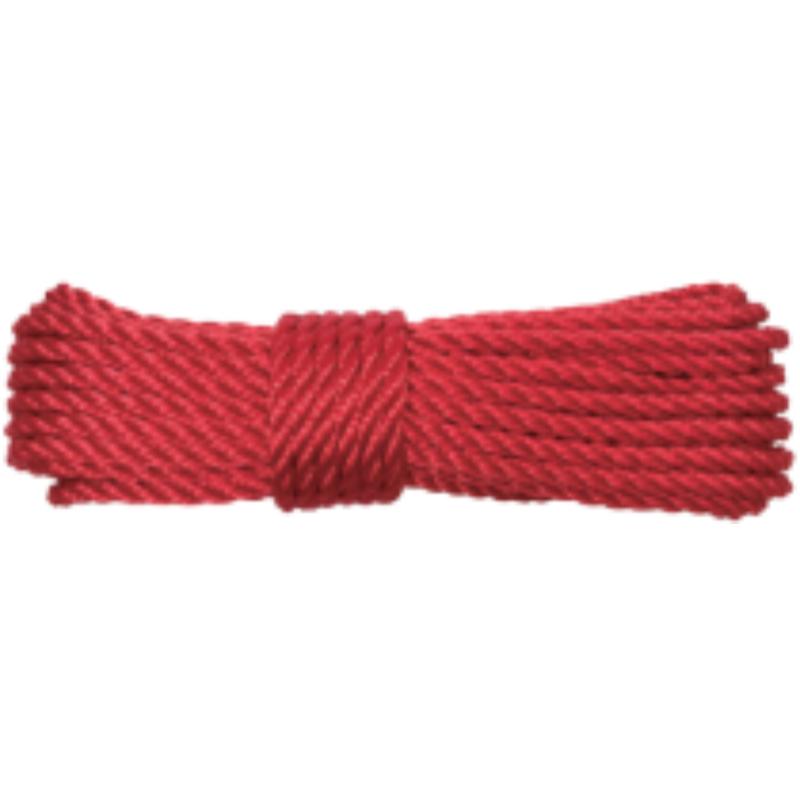
Multifilament yarn is made from many fine, continuous filaments gathered into one yarn bundle. In finished rope, this construction commonly produces a smoother, softer and more flexible hand than a coarse filament or film-based alternative. It is often selected where handling comfort, a more refined appearance or flexibility matters to the buyer and end user.
Multifilament is not a performance guarantee by itself. The final result still depends on polymer grade, strand design, rope construction, diameter, finish and the use environment. However, it is an important specification because it establishes what kind of surface and handling character the buyer expects.
Monofilament yarn uses single, relatively thicker filaments. In a rope, these yarns can create a firmer, more visibly textured surface than multifilament. The exact feel and properties vary with the material and final construction, so a buyer should always approve a physical sample rather than treating “monofilament” as a complete technical description.
Monofilament constructions are often evaluated for practical outdoor, marine-adjacent, agricultural or utility products where the buyer wants a functional rope and a defined price-performance position. In some product ranges, the more open surface can be part of the expected visual character. In others, it may be less suitable if the brand is seeking a soft premium hand feel.
Split-film yarn starts as an extruded plastic film. The film is slit into narrow tapes and drawn or processed for use in rope or twine. In the market, split-film construction is frequently associated with economical utility rope, baler twine and other products where a practical, volume-oriented solution is more important than a soft premium finish.
The word “film” should not be used as a shortcut for poor quality. A split-film rope must still be specified and inspected for the actual application. Polymer grade, UV package, twist balance, diameter, packing and the intended loading conditions all remain relevant. The key commercial point is that split-film and multifilament rope are different constructions and should be priced, sampled and marketed accordingly.
For a buyer, a split-film option can be useful when cost control, high-volume packing or a familiar agricultural/utility format takes priority. It is usually not the right substitute when a customer explicitly wants a soft multifilament hand feel or a more refined retail presentation.
| Construction | Typical surface and handling character | Commercial use case to evaluate | What to confirm with the supplier |
|---|---|---|---|
| Multifilament | Fine-fibre, softer and generally more flexible in feel. | Premium utility, marine-oriented, retail and repeated-handling rope lines. | Polymer, filament type, finished construction, colour, diameter and sample hand feel. |
| Monofilament | Firmer and more visibly textured; exact feel varies with material and design. | Functional outdoor, agricultural, utility and marine-adjacent products. | Filament profile, stiffness, abrasion exposure, finish and sample appearance. |
| Split film | Tape-like yarn structure; commonly positioned for economical and volume-oriented products. | Utility rope, agricultural twine and price-sensitive high-volume programs. | Film quality, UV requirement, rope construction, packing format and use conditions. |
The table is a sourcing framework, not a strength chart. Do not assume one construction has a fixed advantage over another at every diameter or in every polymer. Compare supplier offers by product-specific data and an approved sample.
When the yarn construction changes, the rest of the specification needs to be checked again. It is not enough to replace “multifilament” with “split film” on a quote while keeping every other detail unchanged. The buyer should reconfirm the following fields:
Two quotations can both say “8 mm PP three-strand rope” while describing different products. One may be multifilament, one may be monofilament and one may be split film. If the yarn type, coil length, net weight, end finish and packaging are not aligned, the price comparison is not meaningful.
| Quotation field | Why it matters | Buyer instruction |
|---|---|---|
| Polymer and yarn type | Prevents substitution between multifilament, monofilament and split film. | Write the exact material and yarn construction on every RFQ. |
| Finished construction | Twisted and braided products should not be compared as equivalent. | State three-strand, four-strand, braid type or other final construction. |
| Length, diameter and weight | Clarifies what is actually supplied per unit. | Request the tolerance and the measuring method where relevant. |
| Strength statement | Stops an average figure from being treated as a minimum or working-load limit. | Request product-specific test information and define the intended use. |
| Packaging | Retail-ready packs, labels and cartons affect cost and customer experience. | Attach approved artwork and carton-marking requirements. |
For a higher-value retail or marine-oriented range, a buyer may prioritize multifilament construction because the product needs flexibility, a more refined surface and predictable presentation. For a functional utility or outdoor range, monofilament may be an appropriate option when its surface and cost position fit the market. For baler, agricultural or high-volume utility products, split film may be the construction worth evaluating first.
Those are starting points, not rules. The correct choice depends on the finished product, exposure conditions, customer expectations and the supplier’s actual specification. If a rope will carry consequential loads, be used around people, or be used in a regulated application, confirm the complete system requirements with qualified personnel and the relevant product documentation.
Include a short construction check in the inspection plan before the order is produced. It helps prevent a commercially important substitution from being discovered only after the goods arrive.
No. Multifilament is often chosen for its finer feel and flexibility, while monofilament can suit practical utility applications. The product’s use, target customer and full specification should decide.
Market terminology can vary. Ask the supplier to state the raw-material form and finished construction rather than relying only on a trade name. If the product is intended to match an existing item, send a sample for confirmation.
Only after checking that the intended application, customer expectation, surface feel, packaging and product-specific performance requirements still match. It should be treated as a product change, not a price-only substitution.
Send the polymer, yarn construction, finished rope construction, diameter, length, colour, end finish, packing, target use, expected volume and destination market. Attach a sample or reference photo when appearance is important.
Send RIOOP your application, target material, yarn construction, diameter, coil length, packaging and expected order volume. We can help you turn those requirements into a clearer product specification for sampling and quotation.
Explore RIOOP Twisted RopeRelated reading: PP Flat Filament / Danline Rope: A Practical Guide to Material, Usage, and Selection. Confirm final product availability, test information and application suitability at enquiry.
 Hot News
2026-10-15
2026-10-01
2026-09-16
2026-09-01
2026-08-07
2026-07-23